

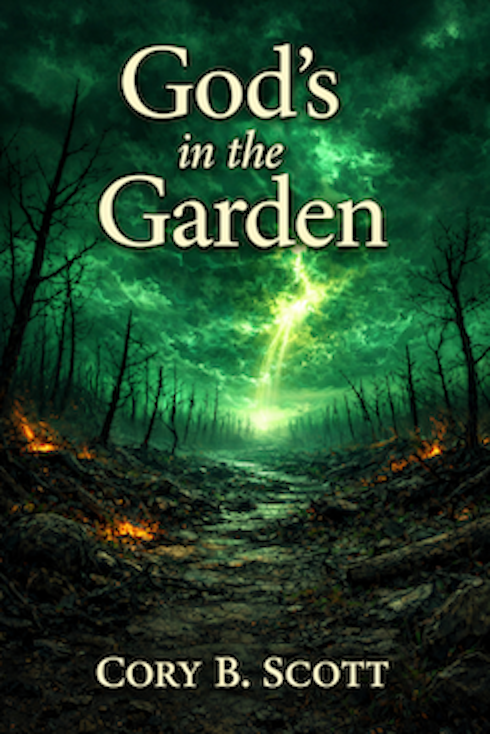
This is a book for seekers, skeptics, and anyone who has ever questioned what survives when certainty falls away.

God’s in the Garden is a raw, metaphor-driven exploration of faith under pressure — a descent into doubt, darkness, and the psychological terrain beneath belief.
Blending memoir, myth, art, and allegory, Cory B. Scott traces a deeply personal journey through loss, addiction, spiritual disillusionment, and the stubborn human need for meaning. Written during a pivotal season of his life, this book does not offer easy answers — only an unflinching account of what happens when inherited faith no longer holds.
This is a book for seekers, skeptics, and anyone who has ever questioned what survives when certainty falls away.
Author’s Context Note:
God’s in the Garden was written during a formative period in Cory B. Scott’s life and reflects the questions, struggles, and spiritual framework he was working within at the time. While his beliefs have since evolved, the book stands as an honest artifact of that season — a testament to the courage it takes to question inherited truths and follow a search wherever it leads.
God’s in the Garden is not a devotional — it is a confrontation.
Written during a period of profound personal upheaval, this book follows a symbolic journey through the Garden of Eden as a living metaphor for belief, innocence, corruption, exile, and the search for return. Each section mirrors a phase of the author’s life, weaving together memoir, philosophical reflection, short stories, poems, drawings, and cultural references to explore how faith is formed, fractured, and transformed.
The narrative moves through childhood belief, toxic authority, addiction, spiritual manipulation, and existential doubt — asking difficult questions along the way:
What happens when the God you were taught to trust no longer resembles the reality you’re living?
What survives when certainty collapses?
And is there something worth salvaging on the other side of belief?
Drawing inspiration from myth, psychology, and thinkers like Joseph Campbell, God’s in the Garden treats faith not as doctrine, but as a deeply human attempt to make sense of suffering, love, power, and responsibility. The book neither defends nor dismantles religion. Instead, it documents a sincere search — one that values honesty over comfort and inquiry over conclusion.
This work represents an earlier chapter in the author’s evolving worldview. While his perspectives have continued to develop since its publication, God’s in the Garden remains an unfiltered record of a man grappling with belief at full volume — and refusing to look away.