
The False Binary of Writing with AI: Human Authorship or Machine Creation?
On Assistance, Abdication, and Staying Present in Your Own Work
The Question Everyone Keeps Asking
By now you've either asked it or had it asked of you, usually with the specific tone people reserve for accusing a spouse of eating the last of the Häagen-Dazs ice cream: "Did you write this, or did AI?"
It sounds like a fair question. It has the posture of one: arms crossed, eyebrow raised, morally serious. And I want to be generous to it, because the impulse underneath is real. People are trying to figure out whether there's a person in the room. But smuggled inside the question is an assumption doing all the actual work, and the assumption is this: only one of those two things can be true at a time. Either your hand was on the pen or the machine's was, and never the twain shall touch the same page.
We keep asking whether a human created the work or AI created it, as though intelligence can occupy only one chair at the table, as though the moment a second mind shows up the first one has to get up and leave. That's the false binary. And once you notice it, you start seeing it everywhere, wearing a hundred different outfits, all of them slightly too tight.
Why Binary Thinking Feels So Attractive
I don't blame anyone for reaching for two boxes. Two boxes is a wonderful number of boxes. It's the number you can hold in your head while also parking the car and remembering that your kid has a dentist appointment. The mind loves a clean fork in the road, and it especially loves the versions that come pre-loaded with a hero and a villain:
Human or machine. Original or artificial. Authentic or fraudulent. Independent or assisted. Creator or consumer.
Each of those pairs promises the same thing: that uncertainty can be filed away, that the messy question of who did what and how much can be resolved by picking a side. It's a kind of housekeeping for the mind. You take the warehouse of ambiguity, stamp every crate either "keep" or "throw out," and for a moment the shelves look orderly.
The trouble is that reality never agreed to be shelved this way, and it will not stay in the boxes. How much a person actually shaped a piece of work runs along a wide range, from barely lifting a finger to laboring over every word. Insist on only two labels and the cases sitting in the middle of that range don't disappear. You just force each one into a box it doesn't fit and pretend it belongs there. The student who used a calculator and the student who paid a stranger to sit the whole exam both get filed under "assisted," and the tidy category is now doing something genuinely unfair to one of them. From across the room the binary looks like a coin struck in solid silver. Up close, the plating has begun to peel, and what shows through underneath isn't metal at all. It's wood. We keep spending it anyway, because a coin is easy to pass and nobody bothers to bite down on it.
We Have Never Created Alone
Here's the part that should deflate the whole panic a little, and I mean that kindly. The lone genius conjuring masterpieces out of unassisted brain-lightning is, and always has been, a marketing document. Nobody has ever worked that way. Not you, not Shakespeare, not the person who invented the wheel and definitely borrowed the concept of "round" from watching a rock roll downhill.
Every piece of human work you've ever admired arrived with a supporting cast. Teachers who corrected you before you could correct yourself. Editors who quietly deleted the sentence you were most proud of and were, infuriatingly, right to. Researchers whose footnotes you stand on. Colleagues who said "have you considered that this is nonsense" at the exact moment you needed to hear it. And underneath all of them, a stack of tools so thoroughly absorbed into "just writing" that we forgot they were ever tools at all: the dictionary, the calculator, the camera, the search engine, the word processor that let you move paragraph four to the top without retyping the entire manuscript by candlelight.
Nobody looks at a photographer and says the camera took the picture, even though, mechanically, the camera absolutely took the picture. We understand instinctively that the machine handled the optics while the human handled the seeing, the standing in the cold at 5 a.m., the knowing when to press. Using assistance has never, by itself, meant surrendering authorship. The only question worth anything, the one we've been asking for centuries without noticing, is how the assistance got used.
Assistance does not erase authorship. It reveals where authorship actually lives.
AI Is Different, and Let's Not Pretend Otherwise
Now, if you're the eyebrow-raising type, you've been waiting to object, and you have a point, so let's put it on the table before it gets impatient. AI is not a dictionary. A dictionary sits there, inert, until you go looking for a word; it stores and formats and waits. AI generates. Ask it, and it will hand you language, images, analysis, counterarguments, three alternative outlines, and a fourth you didn't request but secretly needed. It doesn't just hold the raw material; it can produce the thing, or a plausible draft of the thing, while you're still deciding whether you want it.
That is a real difference and it deserves to be treated as one. Pretending the new tool is just a fancier abacus is the kind of move that makes smart people stop listening to you. The leap in capability is genuine.
But here is where the panic overreaches. A more powerful assistant does not automatically imply an absent principal. When your tools can suddenly do more of the manual labor, your job doesn't vanish. It relocates, and it relocates upward. You stop being the person who forms every sentence by hand and become the person who decides which sentences deserve to exist. Directing, judging, shaping, rejecting, revising, standing behind the result: that work didn't get automated. It got promoted to the whole job. The machine took the shovel. You still have to know where to dig, and you're still the one who answers for the hole.
Trade the Binary for a Dial
So let's throw out the two boxes and install something with a range on it. Picture a dial (or see Figure 1), a continuum of human involvement running from one honest extreme to the other.
Turn it all the way down and you get the caricature everyone's afraid of: a person who supplies almost nothing, prompts once, and pastes whatever comes back without reading it too closely. Minimal intention, zero judgment, meaning outsourced entirely. Turn it all the way up and you get someone using the same tool with their whole mind engaged: setting the intention, interrogating every output, throwing most of it away, keeping the fragment that's actually true, owning the final expression down to the punctuation.
Between those two ends is essentially all real work, spread across a thousand gradations, and this is the part I want you to sit with: most of those middle positions are completely legitimate. The point of the dial isn't to draw a virtue line and declare everyone to the left of it a fraud. It's to ask a better question than "human or machine." The better question is what human capacities stayed switched on? A person can use a lot of AI and remain fully present. A person can use almost none and phone the whole thing in. Volume of assistance tells you remarkably little. Presence tells you almost everything.
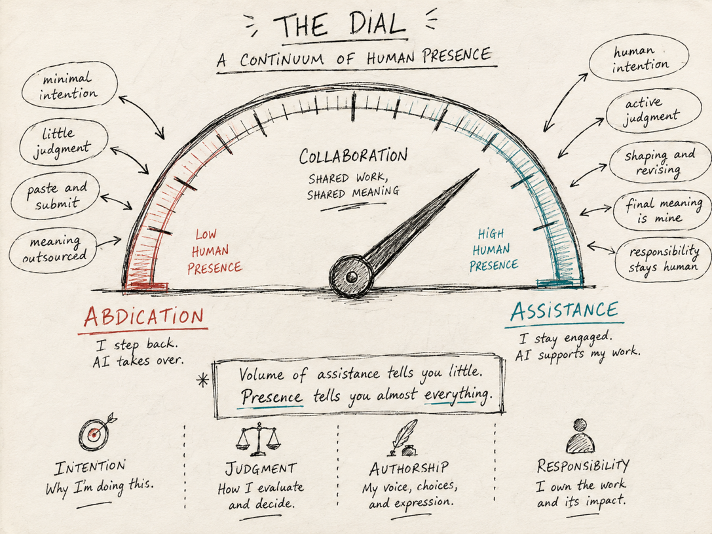
Figure 1- The Proposed Dial
The Real Divide: Assistance Versus Abdication
Which brings us to the turn this whole essay has been walking toward. The meaningful line was never human versus AI. Drawn there, it splits the wrong people onto the wrong sides and lets the actual failure mode walk right through the gate.
The real divide is assistance versus abdication.
Assistance strengthens or extends what you were already doing. It carries the shovel, checks your math, offers a door you hadn't noticed, and hands the work back to you sharper than you left it, with you still very much on the hook. Abdication is the quiet transfer of the things that were supposed to remain yours: the thinking, the judgment, the responsibility. It doesn't help you do the work. It helps you skip the work, and skipping the work has a cost that doesn't show up on the page.
Because the work was never only about the output. Writing the argument is how you find out what you actually think. Wrestling the draft is how you become someone who can wrestle drafts. Assistance helps you do the work. Abdication lets you avoid becoming the person the work was meant to form, and that person was the entire point of doing it.
So the thing to fear was never that the machine contributed. Machines have been contributing since the first sharpened stick. The thing to fear is that somewhere in the process the human quietly got up and left the room, and nobody noticed because the lights were still on and the pages kept coming. The danger isn't that the machine showed up. It's that you didn't.
A Test You Can Actually Run
Abstraction is comforting and useless at 11 p.m. when you're staring at something you made with a tool and wondering whether you get to call it yours. So here's a checklist short enough to remember and pointed enough to sting a little. Four questions:
Intention. Did I decide what this was for? Or did I outsource even the goal, prompting into the void and letting the machine pick a direction while I nodded along?
Judgment. Did I actually evaluate what came back, push on it, doubt it, catch the confident sentence that was quietly wrong? Or did I accept it because it arrived fluent and formatted and I was tired?
Authorship. Did I shape the final meaning and the way it's expressed? Is the emphasis mine? Would I have cut what I cut and kept what I kept, or did I just ship the first plausible version?
Responsibility. Am I willing to stand behind this, to put my name on it, defend it in a room, eat the consequences if it's wrong, without hiding behind "well, the AI said"?
When those four stay human, the machine can participate all it likes without replacing you. When they slide over to the machine one by one, no amount of "but I wrote the prompt" is going to save you, and honestly it shouldn't. This isn't a purity test. It's a mirror. Answer it honestly and you'll usually know exactly where you're standing on the dial, which is more than the "did AI write it" crowd can say.
This Goes Well Beyond Writing
The false binary is a shapeshifter, and it's been busy well outside the essay-and-homework corner.
Teachers keep being handed a fake choice between banning the tools outright and surrendering the whole idea of learning: a metal detector at the classroom door or a white flag, pick one. Both options make the same error, which is to treat the final artifact as the thing we were ever assessing. We weren't. The paper was always a proxy for the reasoning behind it, and for a long time a reliable one, because the only way to get the paper was to do the reasoning. That coupling has come apart. When a student can generate a competent essay in the time it takes to read the prompt, the paper stops proving anything, and the honest response isn't to mourn it. It's to move the assessment to where the reasoning still shows: the revisions, the sources chosen and discarded, the argument a student can defend out loud when you ask why. Design for that and you aren't lowering the bar. You're finally measuring the thing you always claimed to care about.
The same menu gets handed to leaders and to organizations. Trust your gut or trust the algorithm; run the numbers or care about people. But a leader's job was never to personally manufacture every answer. It is shifting toward judging the answers a system hands up, deciding which to trust and which to send back, and owning the outcome either way. The model can surface what a tired human misses at two in the morning. It can't hold the context or carry the accountability, and the organizations that forget this, that pick efficiency and assume humanity will sort itself out, tend to end up with neither.
In each case the fake choice does the same lazy work: it shrinks a wide field of options down to two, so nobody has to think about the middle. And the middle is where the judgment lives, in the unglamorous business of deciding, deliberately, how you are going to use the thing in front of you.
Stop Asking the Wrong Question
So let's go back to where we started, to the crossed arms and the raised eyebrow and the question with the built-in trap. "Did you write it, or did AI?"
Retire it. It was never going to give you a useful answer, because it was measuring the wrong thing: the presence of a machine instead of the presence of a person. Swap it for the question that actually tells you something:
"What part of you stayed present in the work?"
That one you can answer honestly, and it scales to everything: the essay, the strategy, the syllabus, the song. It doesn't care how much the machine did. It cares whether you were still in there while it happened.
The future isn't going to belong to the people who slap the tools away on principle and call it integrity, and it isn't going to belong to the people who hand themselves over wholesale and call it efficiency. It's going to belong to the ones who can enter the partnership without disappearing inside it, the ones who can share the table without giving up the chair.
The One Idea to Remember
If you keep nothing else, keep this. The real choice was never between human creation and AI creation. It's between using assistance and surrendering authorship, and only one of those requires you to leave the room.
Watch on YouTube: https://youtu.be/jpbdXC07NzU?si=9EA8QNJ-YTOQRKqB
Listen to Podcast: https://open.spotify.com/episode/7kxloCYK9KhgGdtk5yp6cM?si=1hPkwaHATkqerHjezsJabg
